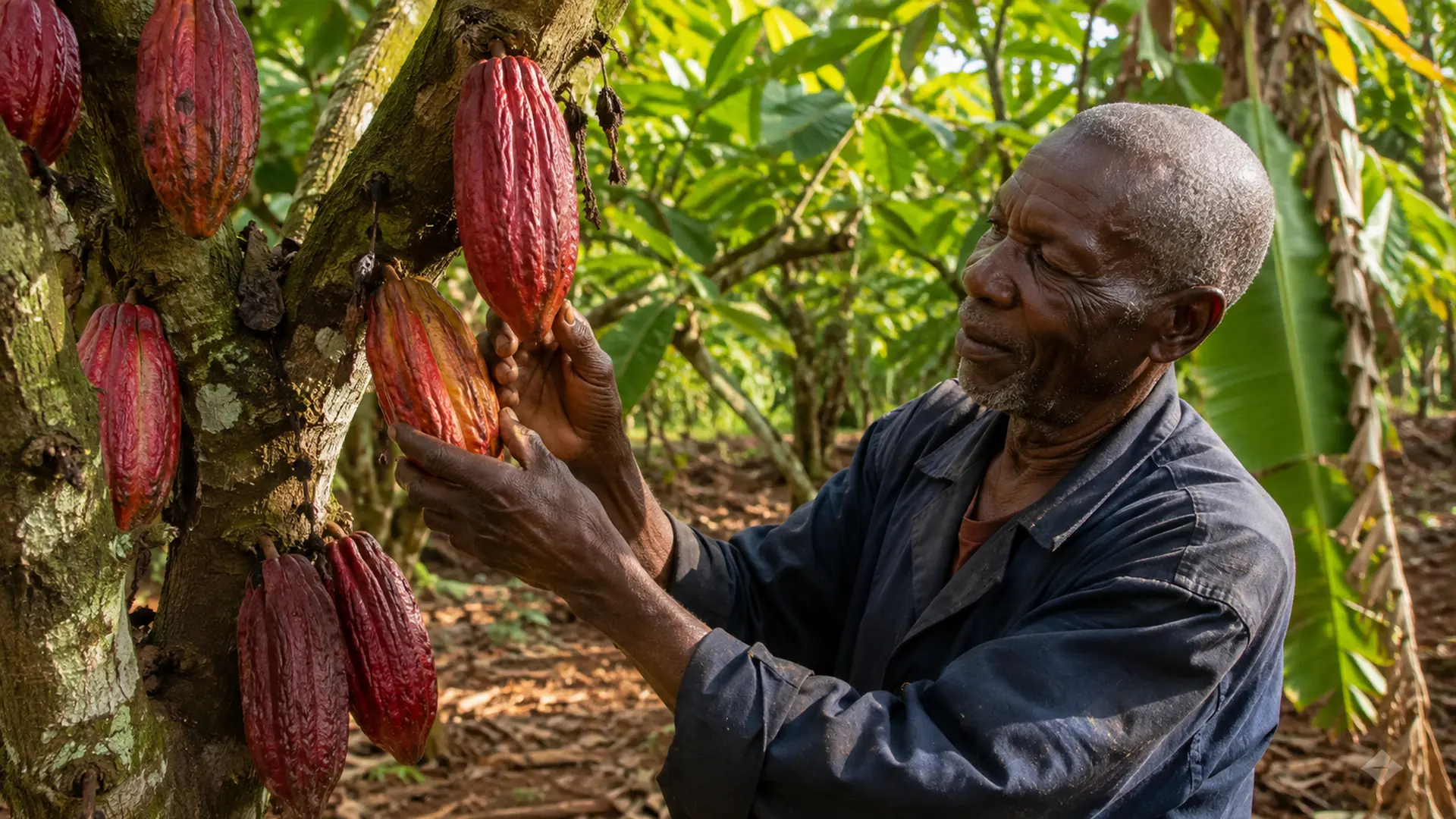
A Ugandan farmer inspecting ripe red cocoa pods growing on a shaded tree in an agroforestry plot

Home / Cocoa

Specialty Cocoa from the Semliki Basin

Centrally fermented in cedar boxes for chocolate makers who taste the difference — consistent, well-fermented beans, lot after lot.

Two farmers harvesting ripe cocoa pods with a hooked knife, one holding a basket of red pods

01 / The Crop

Grown Under Banana Canopy

Bundibugyo District, on the rainforest floor between the Rwenzori Mountains and Semuliki National Park, grows around 70% of Uganda's cocoa — nutty, fruity, equatorial beans with a reputation that reaches craft chocolate makers worldwide. Our pods ripen there and in Mukono, on shaded agroforestry plots under banana canopy, beside food crops, on family land.

Uganda is now one of Africa's top-five cocoa producers, and the crop is grown the way it always has been — without synthetic agrochemicals, by smallholder families who know each tree. In the year to June 2025 the country shipped a record 72,545 tonnes of beans, and cocoa became its second-largest agricultural export.

Farmers gathered around a heap of freshly harvested yellow and green cocoa pods on a woven mat

02 / The Harvest

Ripe Pods, Broken Within 24 Hours

Pods are cut at full ripeness only — amber, orange, and deep red, never green — and broken within 24 hours of harvest. Freshness is the first quality gate: wet beans travel to our fermentary the same day, still in their sweet white mucilage.

Buying wet beans is a deliberate choice. It means fermentation happens under our control, in one place, to one standard — not left to chance across hundreds of farm-gate micro-lots.

Workers emptying fresh white cocoa beans into timber fermentation boxes under an open-sided shelter

03 / Fermentation

Six to Seven Days in Cedar Boxes

Fermentation is where chocolate flavour is made. Our beans ferment centrally for six to seven days in cedar boxes — turned by hand on schedule, temperature-checked daily, covered with banana leaves the way the best fermentaries have always done it.

No artificial enzymes, no accelerants. Just warm air, wild yeasts, and time — the slow chemistry that builds the flavour precursors chocolate makers pay for.

Workers turning and sorting brown cocoa beans spread on long raised drying beds

04 / Drying & Export

Raised Beds, Cut Tests, Clean Documents

Fermented beans dry slowly on raised African beds to ≤7.5% moisture — the ISO 2451 loading standard — then pass hand-sorting and a cut test on every lot. The brown gradient inside each halved bean tells us the fermentation held; we ship only lots testing ≥90% well fermented.

Beans are packed in 64 kg jute bags, documented with certificate of origin, phytosanitary certificate, and the EUDR traceability data European buyers now require, then containerised for Mombasa.

From Pod to Port

  1. 01. Harvest & Pod Break

    Ripe pods only, broken within 24 hours. Wet beans reach our fermentary the same day.

  2. 02. Ferment & Dry

    Six to seven days in cedar boxes, turned on schedule — then slow drying on raised beds to ≤7.5% moisture.

  3. 03. Sort, Grade & Cut Test

    Hand-sorting, bean counts ≤100/100 g, and a cut test on every lot: ≥90% well fermented or it doesn't ship.

  4. 04. Bag & Export

    64 kg jute bags, full documentation with EUDR traceability data, containerised for FOB Mombasa.

Buyer Specifications

TypeSpecialty Ugandan cocoa, centrally fermented
Cut test≥90% well fermented
Bean count≤100 beans / 100 g
Moisture≤7.5%
Fat content50–57%
Packaging64 kg jute bags, food-grade liner on request
Minimum order1 × 20 ft container (~12.8 t) · trial lots on request
Samples500 g pre-shipment sample by courier, typically within 5 days
DocumentationCertificate of origin · phytosanitary · EUDR traceability data
IncotermsFOB Mombasa · CIF destination port on request

Request a Cocoa Offer

Tell us your volume, grade, and timeline — we reply within 24 hours.

WhatsApp the Trade Desk Use the Enquiry Form

Our Other Crops